Meta's frenemies: collaboration vs co-operation in IP strategy
An in-depth analysis of Meta's Ip strategy and its evolution, as well as the strategic dynamics in relation to its complicated social graph: Apple, Microsoft and Google

Meta has made a big bet on virtual reality headsets, and this is reflected in its IP strategy. Meta's Reality Labs is technically now 10 years old if we mark its origins with the acquisition of Oculus in 2014. Only since 2018 though has Meta's IP strategy reflected a strong commitment to the Reality Labs project. And 2021 marks Meta reporting its quarterly financial results based upon two reportable segments: Family of Apps and Reality Labs.
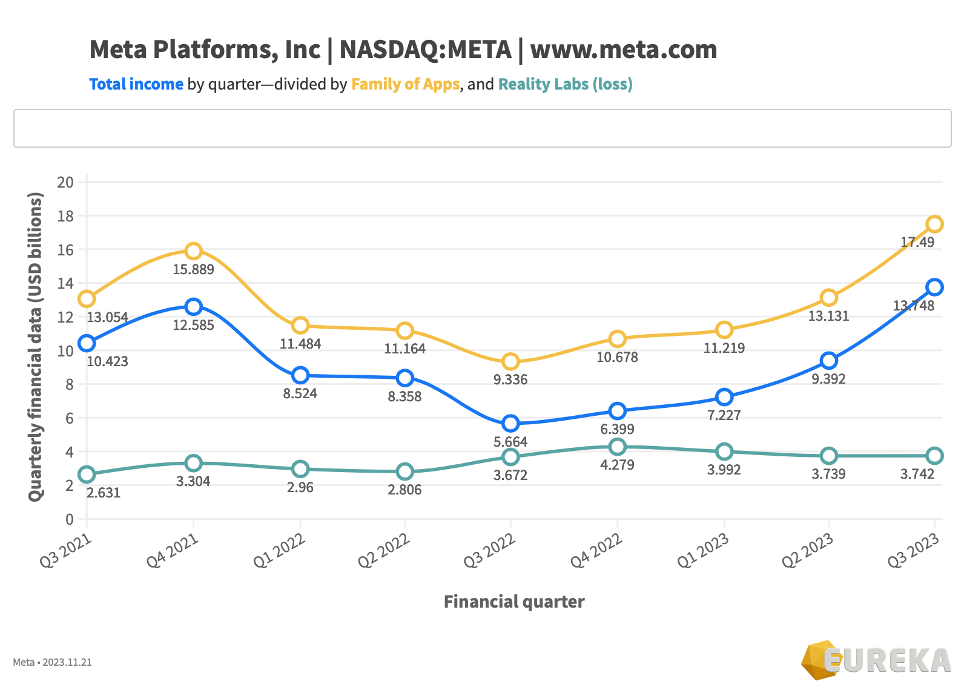
Family of Apps of course is Facebook, Instagram, Messenger and WhatsApp. Reality Labs embraces augmented and virtual reality related consumer hardware, software and content. Reality Labs is a loss maker. Reality Labs earns revenue but this is far outweighed by costs. Reality Labs is underwritten by Family Apps, and this does not look likely to change any time soon.
The numbers for Q4 2023 are now in, and it's really interesting. Reality Labs made a record of over USD1B in revenue, but that is overshadowed by an overall record operating loss of USD4.6B for Reality Labs. Family of Apps has a USD21B operating income from USD38B advertising revenue reported for Q4 2023.
What's intriguing is Meta has burned the boats on its commitment to Reality Labs. There is no backup plan in sight. Which is a bold move given there's no prior experience in hardware. Further, headsets in their current form certainly do not have an assured future. Overall, real demand looks thin. And there's no discussion of when or even if Reality Labs can become profitable.
Why headsets?
Despite operating an incredible business that shows no signs of slowing down, Mark Zuckerberg has evidently felt at the behest of Apple and Google. He has expressed as much in the past.
Why? Apple and Google are the platform holders, they have iOS and Android, operate app stores, and control the handsets. Facebook is the social media app that runs on those handsets, within those operating systems and is downloaded from those app stores.
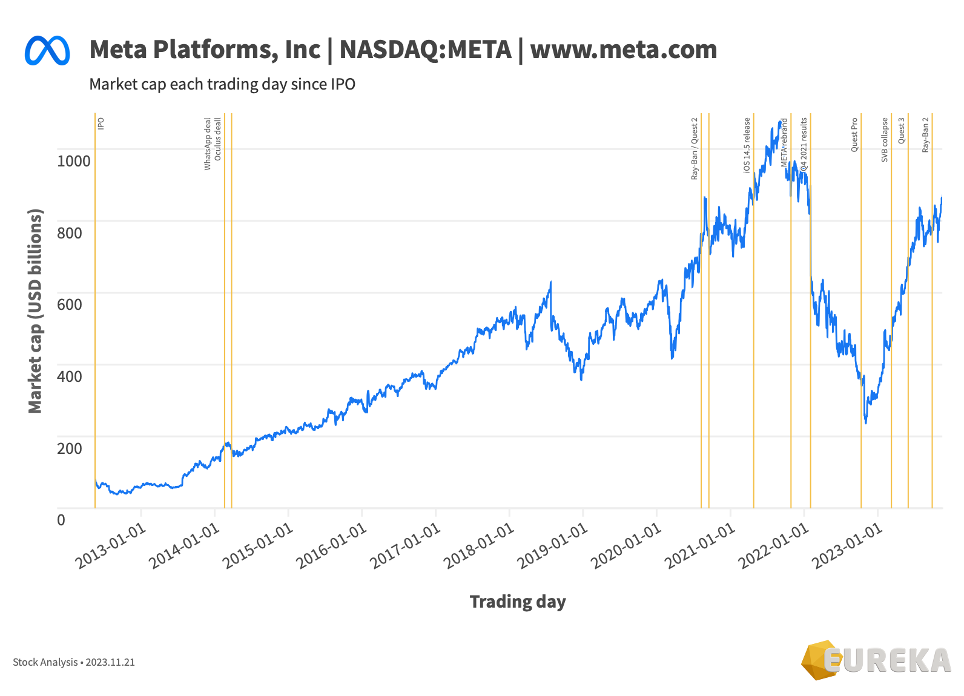
Any unease can only have grown against the long shadow of the metaverse and AI. The fear has proven warranted—though the risks are more prosaic. Apple in April 2021 rolled out a simple iOS update 14.5, which amongst many other features included ‘Ask App Not to Track’.
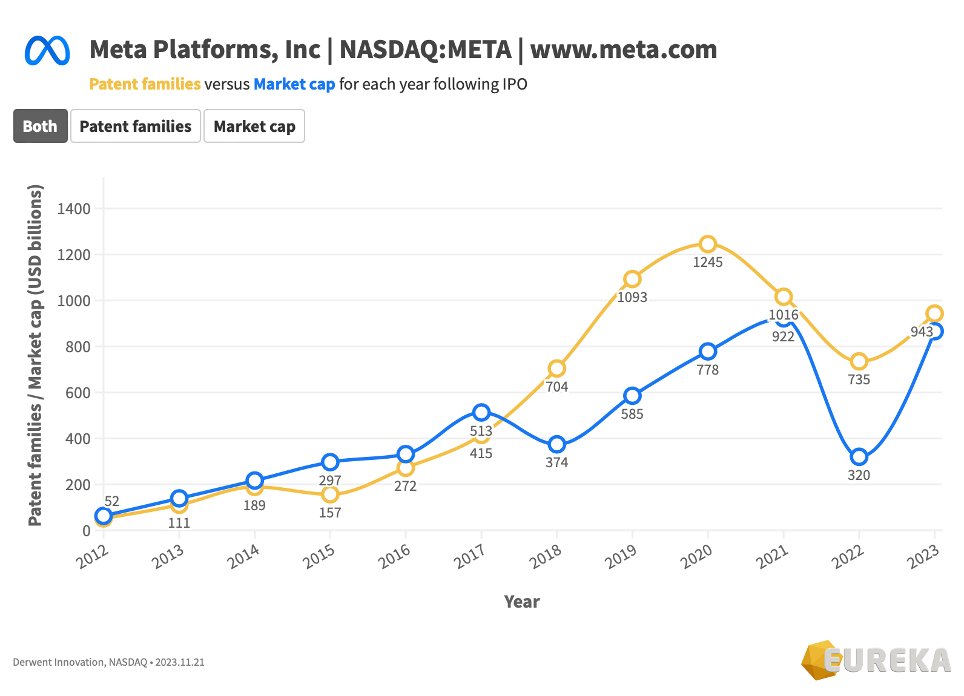
Meta's fortunes soon took a dive, as its advertising model is inherently coupled to tracking users and their interests. Figure 1 below tracks the rise, fall and rise of Meta's following this event. Other macro factors were in play, affecting the general economy and tech sector in particular, but still.
Meta wants to reduce its exposure to the platform holders, and sees a hardware play way to hedge its position. VR headsets remain what it sees as its best option. There is a lot of uncertainty between now and Reality Labs being profitable.
The calculus from Meta must be something like, yes, we're bleeding cash with no end in sight but we can absorb the losses. And we can continue until consumer-led demand for XR and the metaverse snaps into focus. When this occurs, Meta will be positioned to capitalise.
Meta's IP strategy in three acts
The winding arc of Meta's IP strategy is as follows. First there was the hacker era up to IPO, then the listed era post IPO, and now the metaverse era.
- Hacker era IP strategy: File some patents, and opportunistically buy patents if they threaten to compromise immediate operations
- Listed era IP strategy: Seek total IP domination of social networking with acquisition and aggressive filing
- Metaverse era IP strategy: Patent more selectively and strategically, and shift focus to headsets
Patent publications by year
Facebook in its hacker era didn't bother with patenting hardly at all. They made patent 'panic purchases' in the lead up to IPO. This accounts for the pre-IPO surge in patents, and the fact there is a long tail of patents that predate Facebook's launch on 4 February, 2004 as seen in Figure 2 below. (Coincidentally, this was just about the time DARPA's LifeLog project was cancelled. Crazy, huh!)
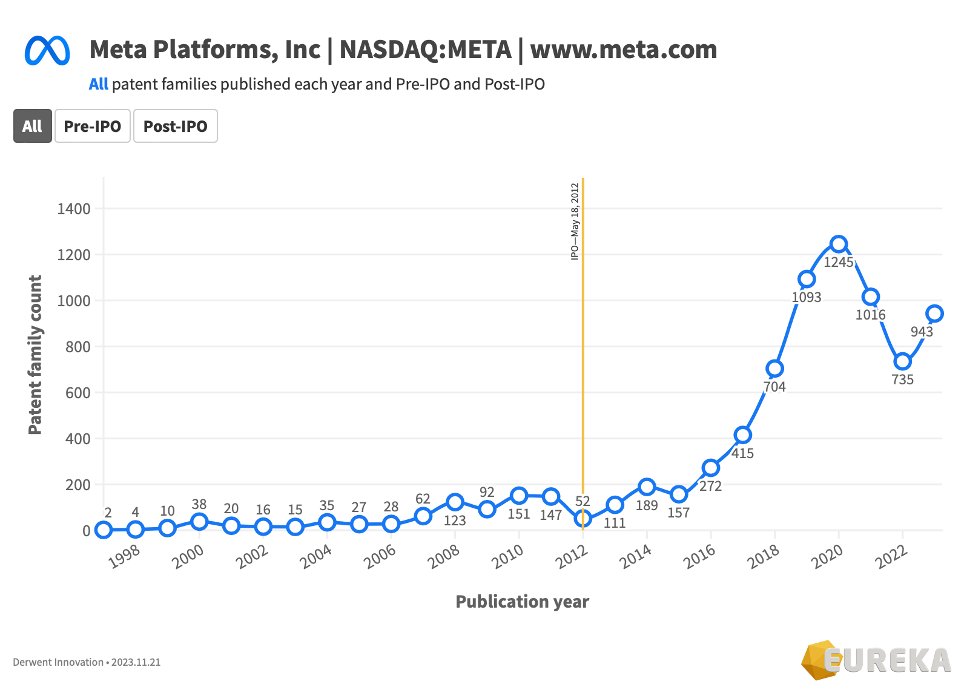
Since IPO, however, patenting began in earnest and grew year on year in step with market cap until 2018. At this point, Meta kept accelerating patent publications, but market cap failed to track, as seen in Figure 3 below.
Reality Labs growing patent portfolio
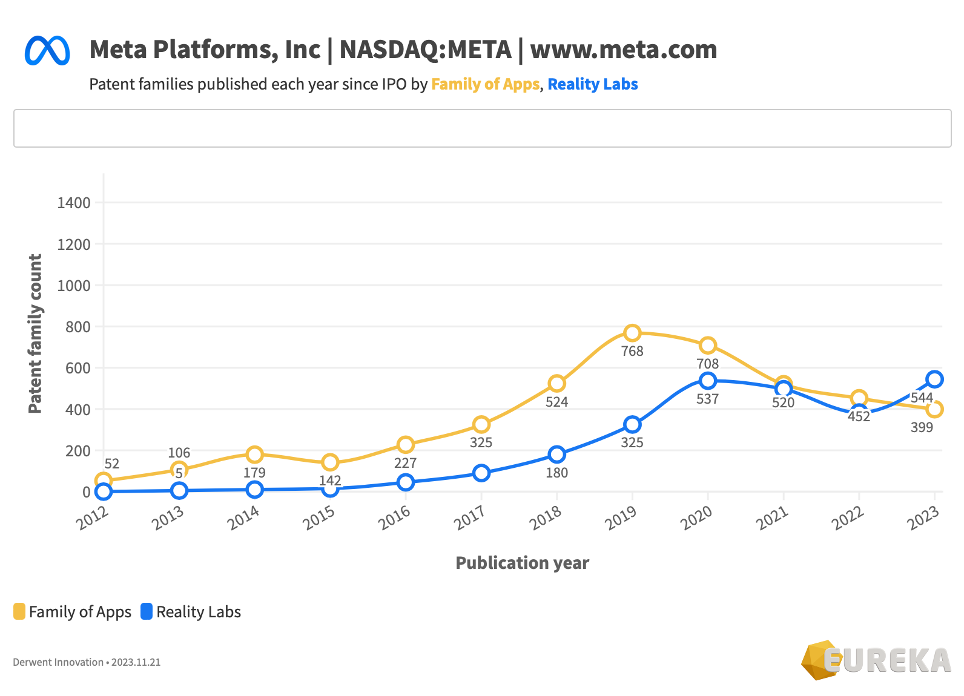
It's simplistic, but 2018 is also when the Reality Labs patents start becoming a greater share of Meta's patenting programme as indicated in Figure 4 below. The disconnect of patent publications and market cap in Figure 3 is far less stark if you only take into account the Family of Apps patent publications.
Meta's big bet on the metaverse is supported by a solid patenting programme. So far it's only making losses, and dragging down Meta's overall performance—as evident in Figure 5 below.
Competitive product landscape
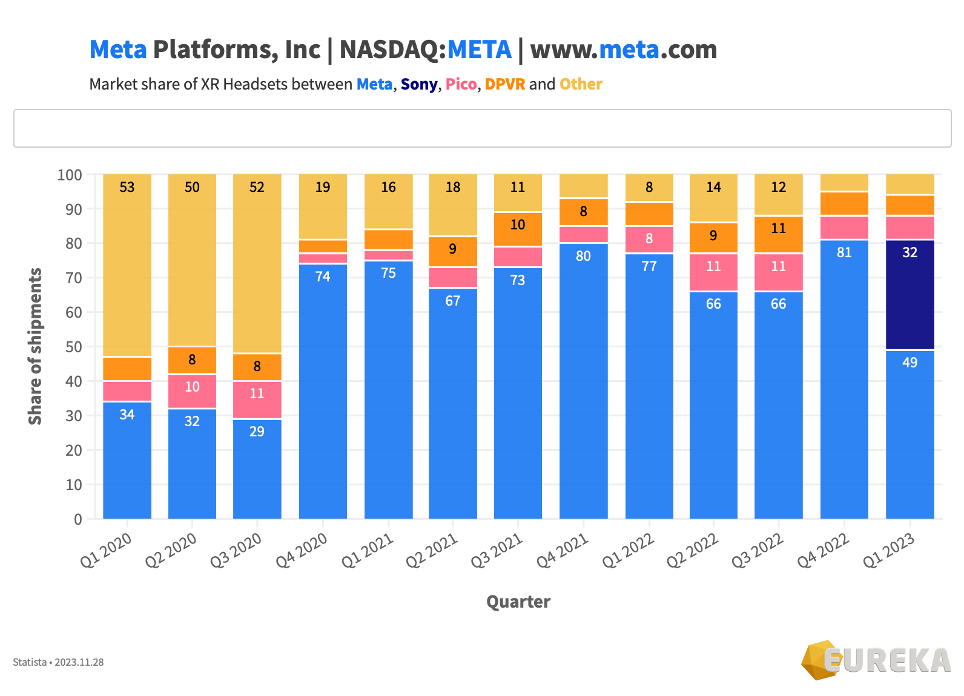
As to share of market, the story is mixed: see Figure 6 below. It looks as if Meta is doing well, but look how easily Sony brought down Meta's numbers in Q1 2023. More recent figures were not available at the time, but we've since learned Sony continued with a strong Q2 and Q3 2023, but contracted to 15% in Q4 2023, with Meta regaining 72% market share. Source: Extended reality (XR) headset vendor shipment share worldwide from 2020 to 2023, by quarter.
This all goes to a key question: how effective in practical terms is the Reality Labs patent portfolio? What does it actually achieve in terms of sustainable competitive advantage for Meta?
Also, Apple's Vision Pro has since launched. Is Apple just flexing on Meta here? Vision Pro is not positioned as Apple's next big thing. Instead, it's a niche prototype for early adopters, and perhaps to signal technical superiority in the category.
Apple's highly polished and well priced offering features as mentioned above its own proprietary operating system visionOS and proprietary silicon in the form of M2 and R1 chipsets powering the experience. It also suffers the usability drawbacks shared by the rest of the headset category.
Meta for all the billions committed to Reality Labs has built its product using the same 'me too' tech stack: Android Open Source Project (AOSP) + Qualcomm's Snapdragon XR2 Platform.
While the patent portfolio is deep and growing, what can the portfolio meaningfully achieve when key components are off-the-shelf?
This is not inspirational given the vast ongoing development costs. It remains to be seen if Meta can make it make sense at some point. And what pivots in commercial strategy and IP strategy might need to play out beforehand.
The metaverse era for Meta looks like it will take a relatively long time to play out. Looming prospects include robotic assistants, connected devices, pervasive autonomous vehicles. And a metaverse connecting it all, which supersedes our current browsers and smartphones, laptops, and desktops likely accessed by whatever comes after headsets.
This work was first published at IP Business Academy in affiliation with Center for International Intellectual Property Studies - CEIPI. The analysis is opinionated and runs to November 2023. The full and original version is available: Meta's frenemies—executing on innovation when your social graph is complicated. Follow this link if the brief extract below interests you. Also, for those who are really interested, an earlier and similar treatment dealing the Facebook's IP strategy I authored in the wake of its 2012 IPO remains published on Lexology: Facebook likes IP. Lastly, for some contemporary context, a third-party piece I relied upon appears in IAM from August 2023—Meet Meta’s patent team, in which diversity strengthens strategy, acquisitions and licensing.