Software patenting trends across Australia, United States Europe
Today we have some remarkable research on software patents:
- United States—68% grant rate
- Australia—54% grant rate
- Europe—27% grant rate

UPDATE (5 February 2026): As of 5 February 2026 there is now definitive confirmation via the conclusion of the Aristocrat litigation that the law of patent eligibility returns to 'established principles', thus providing a more generous framework for patent applicants. Refer to commentary after 5 February 2026 that takes into consideration this important development. At this stage, other is anticipated that Australian grant rates should align more closely with United States than Europe once examination fully reflects the legal implications of this development.
IP Australia commissioned the Centre for Transformative Innovation at Swinburne University of Technology to conduct a comparative analysis between computer implemented invention (CII) patenting activities, both the filing of patent applications and their outcomes, in Australia and other jurisdictions (namely, Europe and the United States).
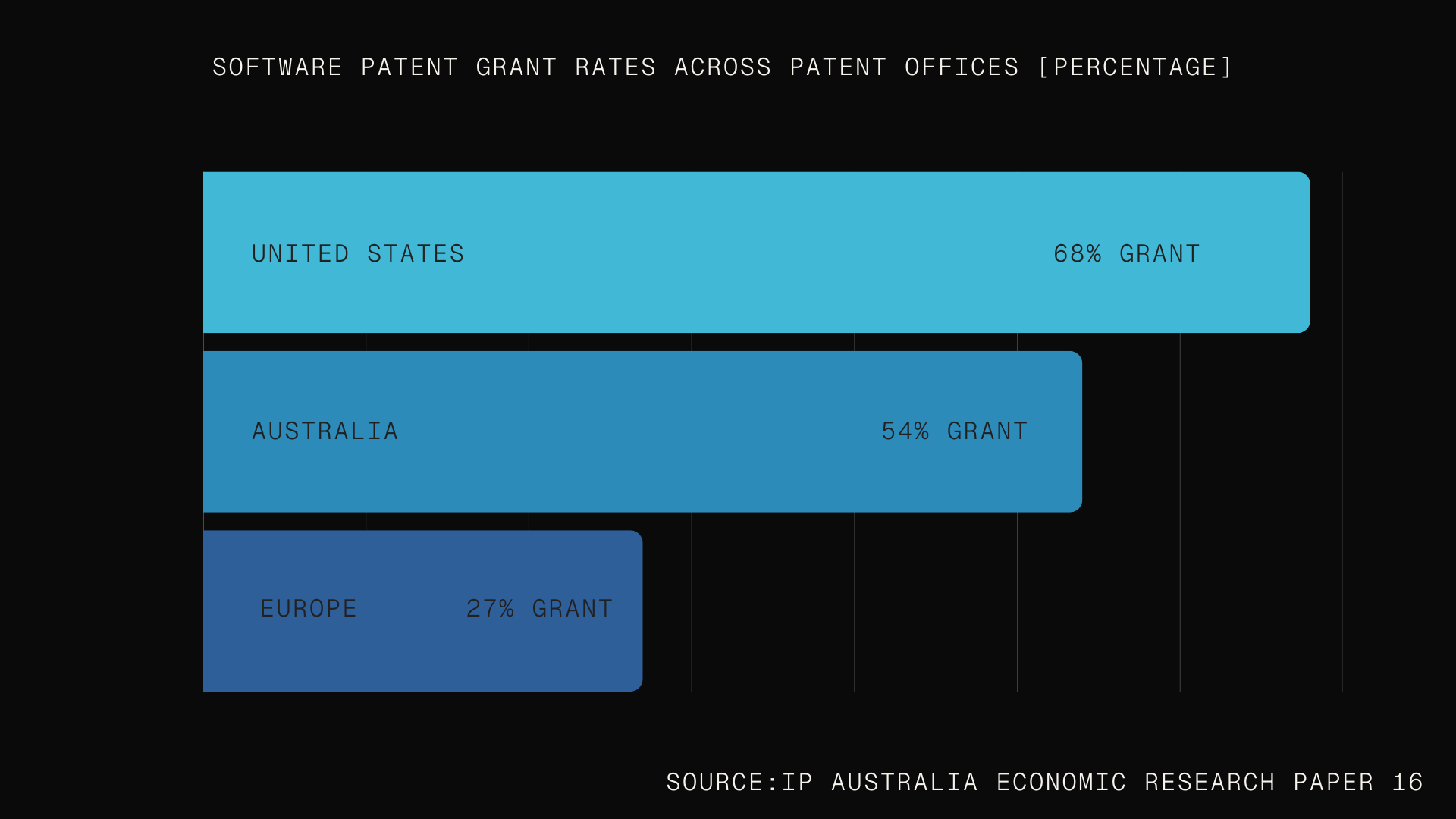
The main takeaway for applicants in the software space is how much more generous patenting standards are in the United States compared to Europe. This is welcome, as the United States is often a critical jurisdiction for software products. These are of course averages, and a lot depends upon how well the case is prepared, and the reception by the individual examiner and their art group. We know in detail, statistically, the idiosyncratic behaviour individual examiners at USPTO display in their examination metrics—compared to their own art groups and the entire USPTO. While success in Europe may be lower, there is a more regimented approach to the inherent patentability of different types of subject matter which can be consulted to guide filing decisions. One excellent guide is: The EUROPEAN SOFTWARE PATENTS Knowledge Base from Bardehle Pagenberg.
Key findings
- Computer implemented inventions (CIIs) account for 32% of patent filings in Australia.
- Around 6% of all patent filings in Australia are CII patents at the margins of patent subject matter eligibility, similar to those that receive a manner of manufacture objection in Australia.
- Australia is less likely to grant such applications than the USPTO and more likely to grant such applications than the EPO.
- After first filing at the USPTO applicants are half as likely to file equivalent patents in Australia if the patent is for a CII invention compared to the average patent. However, that effect is partially mitigated if the patent has high economic and technological value.
- The Australian court decision in Research Affiliates vs Commissioner of Patents [2014] reduced the likelihood of past CII applicants to IP Australia filing subsequent CII patents in Australia by up to 23 percentage points. Domestic innovators were among the least impacted in this behaviour.