On the move: patenting the software layer behind mobility
Vehicle software is patentable, and companies from Onewheel to John Deere are patenting software-implemented functionality at every layer of the stack. Sixteen real examples show what gets protected, followed by four questions for finding the patentable parts of your own product.

Much of the hardware in a modern vehicle can be bought. Motors, battery packs and controllers are available to anyone with a purchase order. What is harder to buy is the software that senses, decides and acts, and that software can be patented. This needs to be custom developed, and other that development implements patentable inventions.
Yes software can be patented
Many founders assume software sits outside the patent system. It doesn't. The tests differ from country to country, but the broad position is consistent: software is patentable when it produces a technical result, and is not when it amounts to an abstract idea or a business scheme run on a computer. Software that controls a machine sits at the comfortable end of that line.
The protection can take several forms, and a single invention is often claimed in more than one:
- As a process: the steps a controller performs, such as measuring lean angle, calculating a limit and capping brake pressure.
- As a system: the vehicle, or the combination of sensors, controller and actuators configured to perform those steps.
- As a component: a single component that carries the invention, such as a derailleur, a damper or a control unit. This matters when a supplier, not the vehicle maker, builds the component.
The subject matter is just as varied. Patents in this field cover control logic, sensing and estimation, communication protocols, user interfaces, update mechanisms and security. The examples below walk up the stack. While the examples are drawn from the United States patent literature, this is illustrative and generally the same principles will apply across to other patenting destinations such as Australia, Europe, China, Japan and Korea.
Real word mobility examples
What's interesting about these examples is you can browse the various inventions these companies have turned into exclusive patent rights. And inspect the level and type of disclosure, and also the boundaries of the exclusive rights of these patents in the patent claims.
Battery and thermal
Rivian (US 11,993,177) predicts thermal demand along a planned route, so the battery can be cooled ahead of a charging stop or warmed in freezing conditions.
Zero Motorcycles (US 12,074,497) covers a liquid-cooled motor enclosure for two-wheeled electric vehicles, with an inner shell that conducts heat better than the outer.
Motor and controller
Shimano (US 9,663,187) describes an e-bike controller that switches between two states in which the assist motor responds at different speeds to changes in pedalling force.
Future Motion, maker of the Onewheel (US 9,101,817), describes a one-wheeled board in which a sensor measures the board's orientation and a motor controller drives the hub motor from that reading.
Dynamics and safety
Bosch (US 9,840,239) sets a maximum braking threshold for a motorcycle that is leaned over in a corner and prevents the bike from exceeding it.
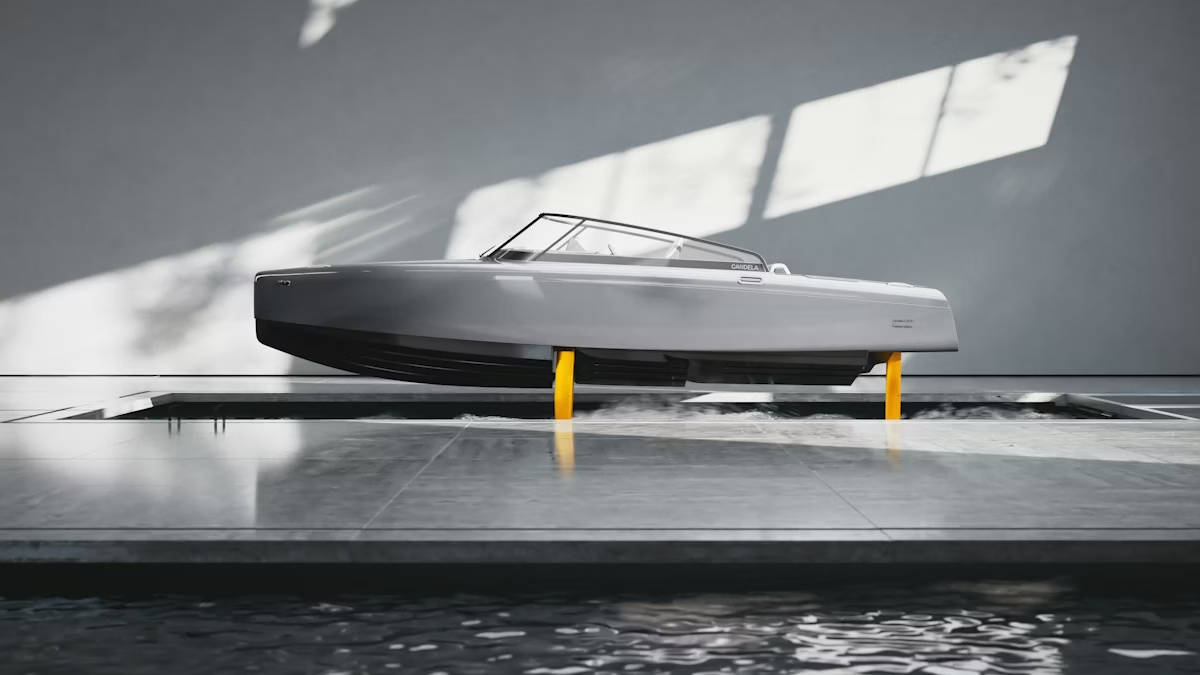
Candela (US 12,054,225) describes a hydrofoil boat controller that reads the water surface ahead of the foil, predicts wave acceleration with a neural network, and sets the foil's angle of attack for a route that minimises acceleration.
Latency-critical actuation
SRAM (US 8,909,424) covers wireless gear shifting on low power: the duration of the shift signal is set relative to the receiver's wake cycle, and a vibration sensor wakes the derailleur.
FOX Factory (US 11,833,876), titled "Rough road detection", relates to using sensor data to control an active valve damper.
Driver/rider interface
Polaris (US 12,038,301) describes an off-road vehicle display that maps the location of a second vehicle and can warn when the two are on a collision course.
Brunswick (US 12,371,140) describes a docking interface for boats that identifies a potential docking surface from proximity sensors and shows its direction on a display. [VERIFY: confirm Brunswick is the assignee]
Connectivity and over-the-air updates
Hyundai and Kia (US 11,900,095) allow an over-the-air update only when the vehicle's power supply can deliver more than the update needs.
John Deere (US 12,140,971) describes a remote system that displays the machine settings of a combine working in the field and sends adjustments that are applied automatically while the operator keeps harvesting.
Vehicle-to-vehicle and fleet
Peloton Technology, the truck platooning company (US 12,346,125), covers a convoy control system that holds the gap between a lead truck and a following truck by controlling acceleration and deceleration from brake and separation sensor data.
Bird (US 11,854,073) decides whether each shared scooter in a fleet is available based on its battery charge, location and the time of day.
Security
Volvo Trucks (US 9,558,342), titled "Secured repair data package", relates to controlling who is authorised to update the software in a truck's electronic control units.
Kubota, the tractor maker (US 11,898,323), relates to authentication between a tractor and the equipment attached to it, with the authentication work shared between two communication devices so that the controller does not need to be high performing.
What the examples have in common
Most of these patents tie software to a physical constraint: a battery that must be at temperature before it charges, a receiver that must sleep to save power, a brake that must stay within what a leaning tyre can hold. That link to the physical world is what helps mobility software clear the patentability tests, and it is the thing to look for in your own product.
Finding what is patentable in your own product
A new mobility product often has unique advantages of features that reflect its format or application, and is something valuable to function or valued by customers. And those features of advantages are typically built upon real and non-obvious engineering effort. This means that if you wish there is likely a prospect that you can successfully patent. Work through your own solution stack layer-by-layer, and consider four questions:
- Is it unique? Look for what your system does that a competitor's does not, and for the problems the off-the-shelf components did not solve. The decisions your engineers argued over longest are usually the place to start.
- Is it unpublished? A patent needs the invention to be new, and your own launch, demo, app release or shipped firmware can count against you. Some countries, including Australia and the United States, offer a grace period; many others effectively do not. Treat it as a safety net and make the decision before you disclose.
- Is it technically valuable? Name the measurable result: faster response, less heat, longer range, a safer failure. That result is what an examiner looks for, and what separates an invention from a feature description.
- Is it commercially valuable? Ask whether a competitor would need to do the same thing to match you, and whether you could tell if they did. Behaviour that can be observed from outside the vehicle suits a patent. Logic that stays hidden in the firmware may be better kept as a trade secret.
A feature that passes all four hurdles is worth a conversation before your next release.